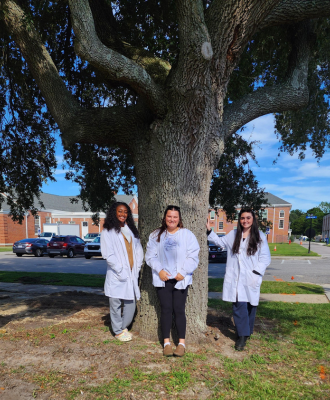
Elizabeth City, N.C. — Using one of the oldest oak trees on Elizabeth City State University's (ECSU) campus as their living laboratory, ECSU biology students have become the first researchers from a historically Black college or university (HBCU) to participate in the American Campus Tree Genome Project and have their work accepted into a worldwide genetic database. This research is now publicly available through the National Center for Biotechnology Information (NCBI), one of the world's largest repositories of genetic information.
The project involved students in BIOL 499: Biological Research and volunteer researchers who partnered with faculty investigator Alex Harkess, Ph.D., and team members Lauren Whitt and Sarah Carey of the HudsonAlpha Institute for Biotechnology. The student researchers included Nicole Villardi, Camdyn Peck, Laneya Evans, Zakiya Sledge, Nyaziah Sears, Justin Franklin, Juelle St. Clair and Angelina Sanchez.
According to Margaret Young, professor of biology and faculty expert in plant tissue culture, the project marked a significant milestone for both the university and the HBCU community.
"We are the first HBCU to be part of the American Campus Tree Genome Project, part of Dr. Harkess' National Science Foundation CAREER grant. This is the first time that we are sequencing/annotating a tree on this campus and having the data readily available on NCBI," Young said.
The accomplishment was the culmination of months of hands-on research that exposed students to scientific techniques and technologies rarely experienced at the undergraduate level.
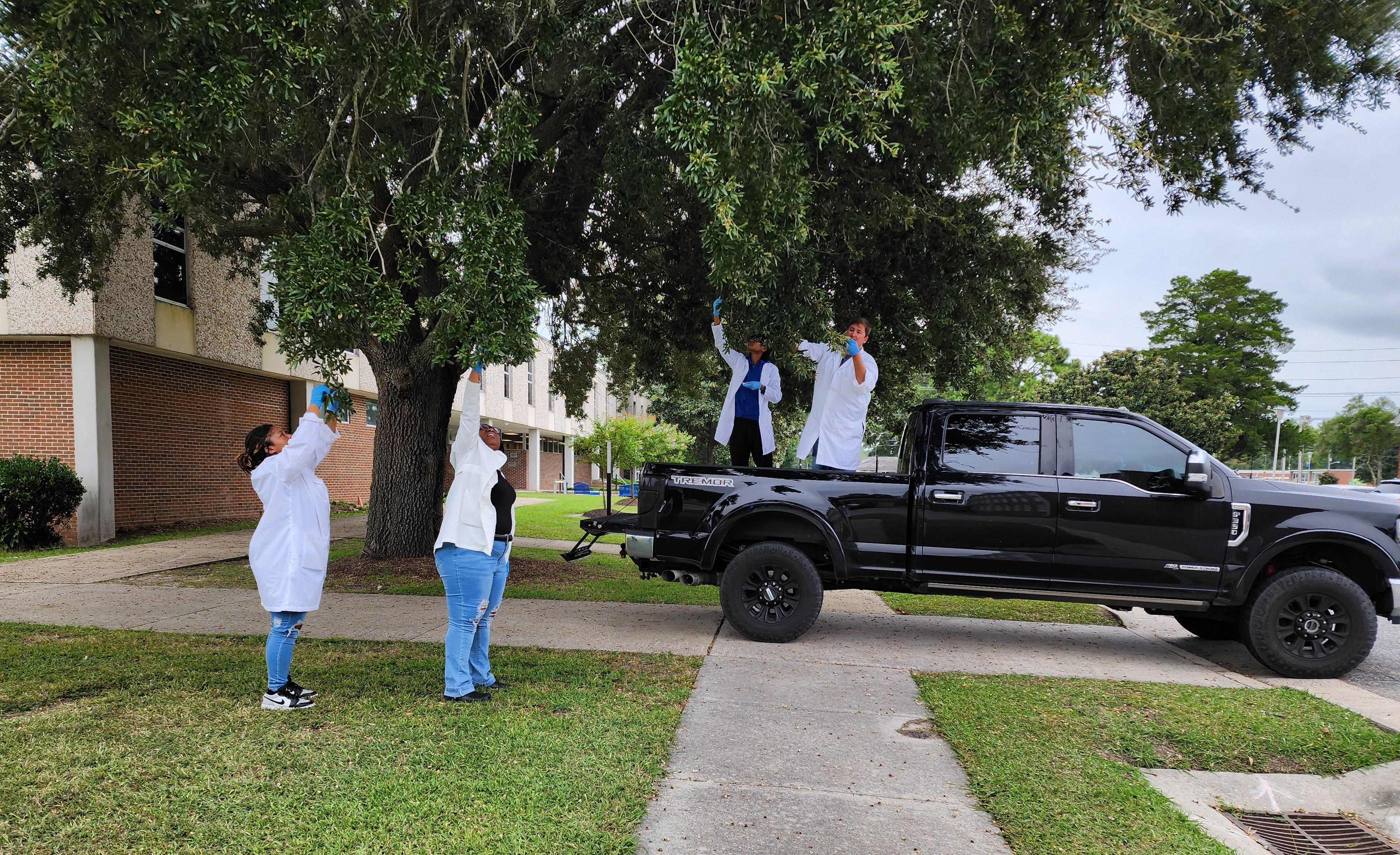
The process began when students collected leaves from the oak tree near the G. R. Little Library and extracted high-quality, molecular-weight genomic DNA from the tree's nuclei, mitochondria and chloroplasts. The DNA was then sent to HudsonAlpha for sequencing. Once the sequencing was completed, researchers returned the chloroplast data to ECSU, where students used bioinformatics tools to identify genes and annotate the genome before submitting the completed work to NCBI.
The annotated chloroplast genome was submitted to the international database under accession PZ337663.1, making the students' research available to scientists and researchers worldwide.
Young said the achievement was particularly noteworthy because each step of the process required a level of precision and expertise that is uncommon for undergraduate researchers.
According to Young, this is rare because it depends on the ability to obtain high-quality data from the sequences, and learning bioinformatics tools (coding) to annotate. “We were praised by Dr. Harkess. Plant DNA can be difficult to extract due to the tough cell walls and the fact that plants store their waste and have secondary compounds in their cells,” she said.
The work also required a significant investment of time and perseverance. Unlike traditional laboratory courses, where experiments are often completed within a few hours, students spent entire days troubleshooting and refining their methods.
"Extracting the DNA took several tries, about 8 hours each from start to finish. This would not work in a traditional lab setting, which is two to three hours," Young said. "Annotating also took several hours. Luckily, the students had done Computer Programming and could figure out the coding when there were hiccups. Dr. Harkess’s staff also helped polish the data. In a course such as Biological Research, there is a lot of latitude—defined meeting times, plus meeting times each week the students decide upon, which makes it ideal for such a project."
The oak tree selected for the project was chosen because of its age and prominence on campus. Beyond providing students with a unique research opportunity, the tree is contributing valuable information to the scientific community's understanding of oak species and their distribution.
"We decided on that tree as it is one of the older oak trees on campus," Young said. "Oak (Quercus genus) has about 680 species and hybrids. This information helps the community understand the distribution of oak. Our species is closely aligned with Quercus gambelii, which originated in the Western US, and some similarities with Quercus macrocarpa, which is native to the eastern US and other species."
The research effort is far from complete. While the chloroplast genome has already been sequenced and annotated, students and faculty researchers will continue their work on the tree's mitochondrial and nuclear genomes, adding to a growing body of scientific knowledge.
For Young and her students, however, seeing their work become part of a global scientific resource was a rewarding milestone already.
"The students were very excited to be part of the American Campus Tree Genome Project," Young said. "I was happy to be part of this collaboration as it increased my knowledge of sequencing and annotating, and it can be used in my other courses. The research available on NCBI is the icing on the cake."
What began with leaves collected from one of ECSU's oldest trees has now become part of a historic first that showcases the university's growing role in undergraduate research and gives students an opportunity to leave a lasting mark on the scientific community.