
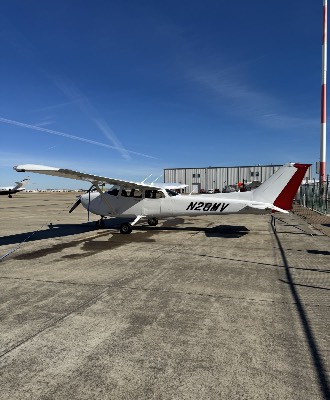
To meet the demands of rapid enrollment growth and a national shortage of aviation professionals, Elizabeth City State University (ECSU) has invested in what it needs most—a new set of wings.
ECSU has purchased a 2018 Cessna 172 G1000 aircraft to help accommodate its growing aviation program. This addition allows more flight hours for student pilots as both enrollment and workforce demand increase.
The aircraft, now the 20th Cessna 172 in ECSU’s training fleet, reflects the university’s response to dramatic aviation enrollment growth, according to Kevin Kupietz, chairpersonand associate professor of emergency management in the Department of Aviation and Emergency Management.
“ECSU has had the proactive vision to purposefully make all of these aircraft as similar as possible to make training more consistent, maintenance more efficient and logistics of parts and operations more secure from external disruptions.”
According to Kupietz, ECSU’s aviation program has been experiencing a tremendous rise as it has worked to have a position of national prominence in preparing top-notch students in the aviation field. “In 2021, the aviation program had 152 students. In the spring of 2026, we have grown to almost 500 students in the program—with 195 of them flying, working on their goals of becoming professional pilots.”
Kupietz said acquiring more aircraft is crucial to providing students with ample flight time and a quicker route to certification, which strengthens the aviation workforce pipeline.
“This aircraft will give ECSU students more airtime, helping them meet ECSU and Federal Aviation Administration (FAA) pilot license requirements faster,” Kupietz said.
The acquisition also aligns with ECSU’s long-term vision for aviation education, including future enrollment growth and expanding flight operations beyond Elizabeth City. Kupietzsaid the university is preparing for this with new regional flight hubs, including the Currituck County Regional Airport project and construction of the university’s School of Aviation facilities. The new aircraft hangar at Currituck is scheduled for completion in Aug. 2026, followed by the flight school facility in July 2027. To promote engagement, ECSU provides live webcams on its Design and Construction website, where individuals can follow the progress of both construction projects.
“As ECSU expects 700 students in the coming years, opening remote hubs like Lenoir in summer 2026 and Currituck in fall 2026, we must expand our fleet to support this growth,” he said.
Equipped with Garmin G1000 avionics, this aircraft supports ECSU’s approach to fleet standardization, enhancing training, maintenance and reliability.
Officials said ECSU buys used aircraft to meet rapid program growth timelines, since new models often have waitlists exceeding two years.
But the aircraft won’t leave the runway just yet.
“This aircraft is undergoing a very rigorous inspection and upgrade process with ECSU’s in-house mechanics to ensure that the aircraft meets ECSU’s high standards of quality and safety,” Kupietz said. “Once this is complete, the aircraft will enter the fleet status to begin training students.”
Kupietz added that purchasing additional aircraft not only shows the institution’s commitment to the growth of its face-to-face programs locally and at the flight hubs, but also supports the new Aviation Distance Education degree option and the newly approved Graduate Certificate in Aviation Leadership.
“More aircraft will allow ECSU to fly more students more often, and put more qualified pilots in the career pools to our aviation industry partners,” he said.
As ECSU’s aviation program continues to rise, the focus shifts from keeping up with the Joneses—because in aviation education, more institutions are finding they have to keep up with ECSU.