Education & Training
Education & Training
The educational effort undertaken through the Consortium for Nuclear Security Advanced Manufacturing Enhanced by Machine Learning (NSAM-ML) partnership is of primary importance. It is designed to significantly increase the participation of minority and underrepresented students in science, technology, engineering and mathematics (STEM), manufacturing science, data science and related disciplines. Since the inception of the consortium, strategies that increase attraction of students to physics, chemistry, materials science and engineering, nanotechnology, and data science careers have been adopted in each of the three minority-serving institutions (MSIs), members of the NSAM-ML Consortium. Various educational activities have been maintained, namely:
Engaging students in conducting independent research projects that are part of the consortium research projects.
Summer programs at Sandia National Lab (SNL), Los Alamos National Lab (LANL) and the Center for Integrated Nanotechnology (CINT) have been organized. In summer 2022, two students joined Sandia National Lab, a third one joined LANL, and a fourth one, a Ph.D. candidate, will join LANL by the end of this summer. He will reside at the Ion Beam Materials Laboratory (IBML) for six months. The student internships focus on research topics of interest to the consortium. All selected students have been prepared during the academic year to promptly and successfully pursue their research in the NNSA Labs. For maximum efficiency, joint advice is carried out by the host scientists and the MSI mentors. As a matter of fact, the principal investigator (PI), Dr. Karoui, and an NSAM-ML postdoc, Dr. Akram are spending the summer at SNL and LANL to ensure successful student internships while they are carrying out research for their project. The graduate student will do advanced research at the IBML that is directly connected to his thesis project.
Undergraduate team research to carry out significant projects, for example, the development of "The NCCU Carbon Nanotube Database for Machine Learning."
Peer mentoring conducted by the Consortium faculties.
Training students in advanced research projects and productive research experiences at the frontiers of materials science, nanotechnology and machine learning is performed with great care by the postdocs and faculty of the Consortium during both the academic semesters and during the summers.
Educational activities that provide the students with skills that clearly increase their competitiveness and success in future material engineering, manufacturing, sensors and careers related to NNSA and the Department of Energy (DOE) as well as other agencies and industry in various high-tech sectors will be engaged in by the faculties.
Students across the NSAM-ML consortium have been engaged in several workshops organized by:
- The MSI, e.g., workshop series on ML by the NCCU Department of Mathematics and Physics
- Our NNSA partners (SNL and LANL), Large-scale Atomic/Molecular Massively Parallel Simulator (LAMMPS), advanced materials characterization techniques, ion beam modification of materials
- Majority universities, e.g., on machine learning (weekly workshops offered nanoHUB at Purdue University), manufacturing 2D materials (nanomanufacturing Node at University of Illinois)
- Research centers, e.g., The Extreme Science and Engineering Discovery Environment (XSEDE): machine learning, exa-scale computing, etc.
- IBM–NCCU Q-HUB: workshops on quantum computing training
- COMSOL multiphysics on finite element analysis (weekly webinars)
- WITec Academy: on advanced nanoprobe techniques
- Bruker on nano-Fourier transform infrared spectroscopy (FTIR)
- Horriba Jobin-Yvon on tip-enhanced Raman spectroscopy (TERS)
NSAM-ML Seminar Series. Consortium scientists and graduate students have offered 20 seminars thus far. These are attended by students, faculties and guests from NNSA partner laboratories.
Course development
Intra-consortium and inter-consortia cooperation led to offering courses in specific classes under the auspices of other MSIPP consortia. For instance, NCCU students will be attending a class at New Mexico State University (NMSU) offered by the Quality Control of Additive Manufacturing (QCAM Consortium) Consortium.
K-12 outreach is nurtured in order to bring high school students and freshmen to the research dynamics.
Each of the NSAM-ML university members has established cooperation with technical colleges in their regions. The goal is to prepare students from their regions and help them to transfer to continue their studies in the MSI.
Training and Research on Nanomaterials Using Supercomputers
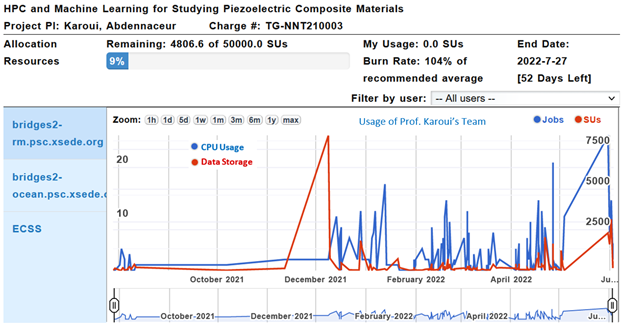
Dr. A. Karoui has been granted supercomputing resources on Bridges-2 supercomputer (the National Science Foundation [NSF]-sponsored Extreme Science and Engineering Discovery Environment [XSEDE]) for his project "HPC and Machine Learning for Studying Piezoelectric Composite Materials." Dr. Fouzia Sahtout is co-principal investigator (PI) on this project, and Dr. Gaolin Miledge is the supercomputing allocation manager.
The allowed Bridges-2 resources are suitable for data production and benchmarking. In addition, faculties, senior scientists and both graduate and undergraduate students received several supporting training sessions from the XSEDE HPC network via their series of webinars and workshops. The NSAM-ML team is proud of making this quality education possible at an HBCU. Our students have become experts in running large materials modeling and simulation programs on supercomputers.
Prior to this undertaking, students were taught the foundation of molecular dynamics (MD) and one of the most used MD software programs, the Large-scale Atomic/Molecular Massively Parallel Simulator (LAMMPS). Our partners at Sandia National Laboratories developed this software, which is still under continuous improvement and enhancements. This open source software has become the standard computer tool for nanomaterial design and beyond and is used world-wide. Through the NSAM-ML, our students have become extremely knowledgeable of MD and analysis tools, an excellent achievement of the NSAM-ML team. By the end of their internship programs, the students become experts in several areas of nanomaterial atomistic and molecular modeling. This advanced education and modern skill set will influence the career of our students, of which the NSAM-ML team is proud.
The project leader, Dr. Fouzia Sahtout, has been working closely with the team members to perform the HPC-based research work and has been training the students, writing scripts and checking the quality of produced data in reference to experimental data, among several other roles in student teaching and mentoring. Since LAMMPS uses the message passing interface (MPI) for parallel communication to handle extremely large high-performance computing (HPC) jobs on large parallel computer clusters, Dr. Sahtout has been striving to communicate her knowledge and experience to the students. She is a specialist in parallel computing. She has pioneered the development of naturally parallel algorithms and has been using MPI for more than two decades.
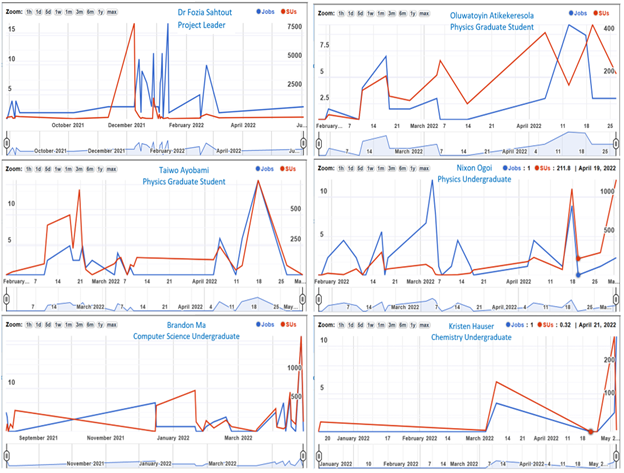
Our students, largely under-represented in the field of HPC, have enjoyed this unique research environment. Two of them are now at Sandia National Labs, and one is at Los Alamos National Lab. They have acquired tremendous scientific knowledge and skills in HPC while using some of the best supercomputers. The XSEDE portal shows a significant supercomputer usage by our students as they performed their research projects.
 |
 |
One of the NSAM-ML sub-projects conducted by student teams is the development of the NCCU Database for Carbon Nanotube, which aims at building datasets on the physical, chemical and electronic properties of carbon nanotubes (CNTs) of all possible chiaralities. The goal of the development of such a database is to provide scientists and material engineers with fundamental data that allows the designing of new nanocomposite materials, using machine learning. At this point, the mechanical properties component is almost completed, and work on the CNT thermal properties has just begun.
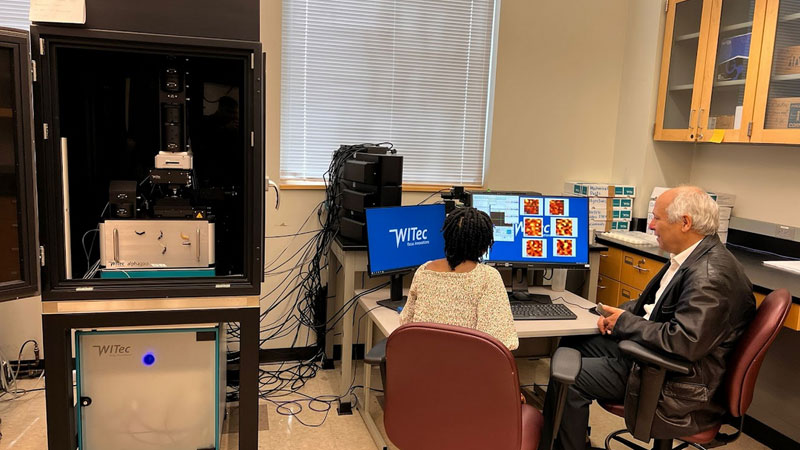
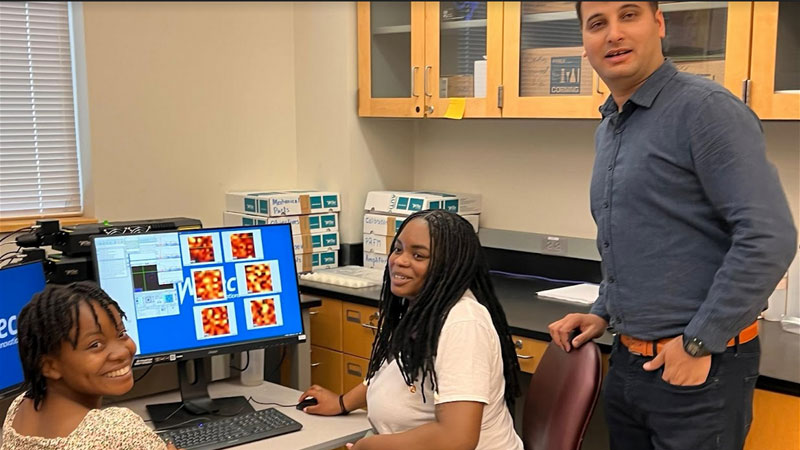
Dr. Karoui is training students on Scanning Confocal Raman spectroscopy to finely detect elements in nanomaterials and identify them. His assistant Dr. Akram teaches Ruth, a graduate student, the characterization of piezoelectric and ferroelectric materials.
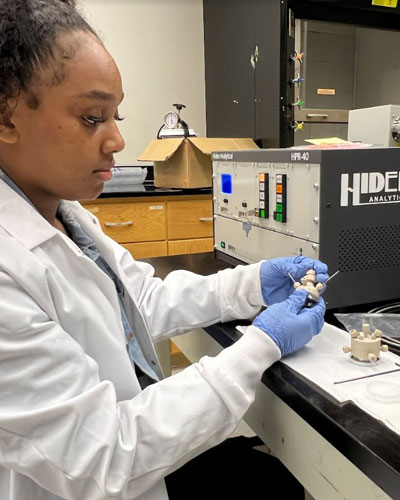
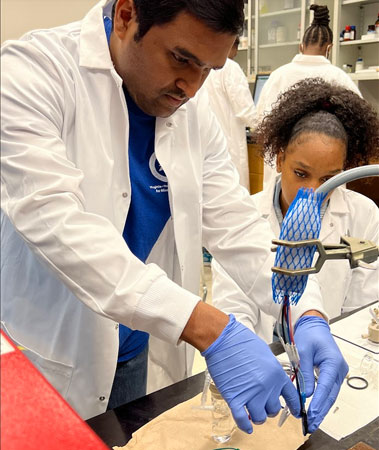
Students from Dr. Kumar’s team, ECSU, working in the electrochemistry laboratory at ECSU. They are learning how to do research in photoelectrochemistry for generating hydrogen from splitting water molecules using solar energy and converting CO2 to alternative fuel or other high-value substances.
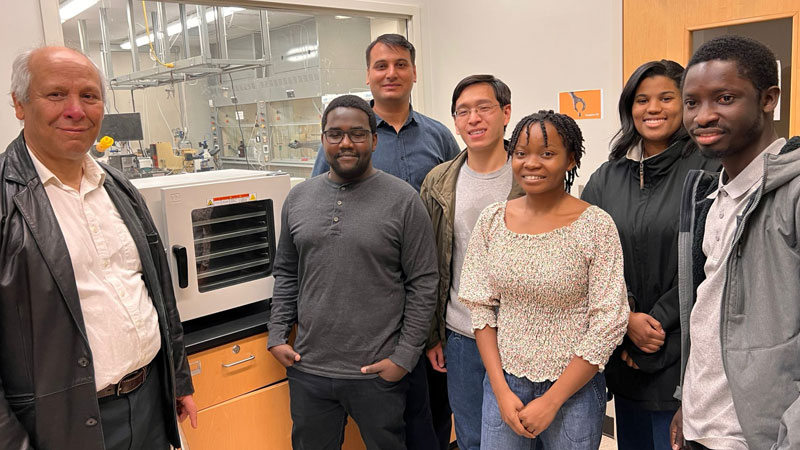
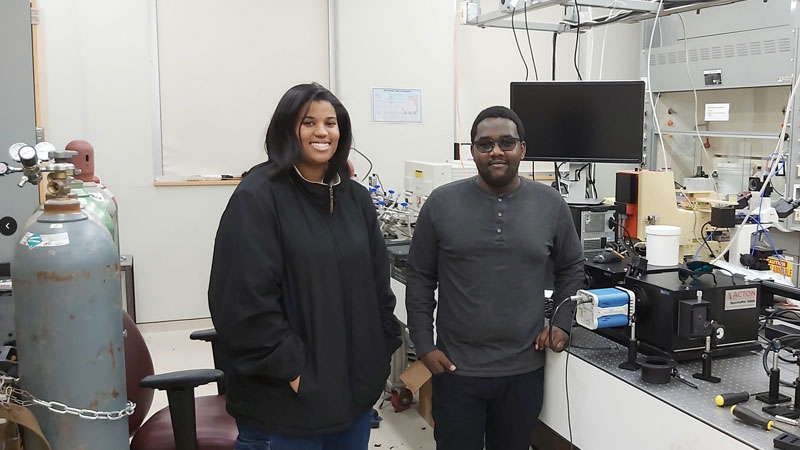
Thanks to partial support of NNSA, a new laboratory for fabrication of ferroelectric and piezoelectric materials is being set up. It will enable new capabilities for fabrication of such materials and many other ceramics and composites. The lab will have great assets for training the students and postdocs.